Best Practices for Seamless IT Service Transition
BLOGS
By Gary Montgomery, CEO
5/19/20255 min read


Transitioning IT services or transforming a digital stack is a high-stakes endeavour that can drive innovation or disrupt operations if not managed properly. A seamless transition is critical to maintaining operational efficiency, minimising downtime and ensuring business continuity. However, organisations face challenges like legacy system complexity, resistance to change, and cybersecurity vulnerabilities, but adopting structured best practices mitigates risks and ensures continuity.
This blog explores best practices for a smooth IT service transition, addressing common challenges and strategies to overcome them - including when to bring in external expertise.
Understanding IT Service Transition
IT service transition refers to the process of moving from one IT environment to another, whether through system upgrades, cloud migrations, vendor changes, or digital transformation initiatives. The goal is to ensure minimal disruption while improving performance, security, and scalability.
A well-executed transition follows structured methodologies, such as ITIL (Information Technology Infrastructure Library) frameworks, which emphasise service design, transition planning, and continual improvement.
Key Challenges in IT Service Transition
Legacy System Complexity
Outdated infrastructure often lacks documentation and integrates poorly with modern solutions, creating migration bottlenecks. For example, transitioning from on-premises servers to cloud platforms can often expose hidden dependencies. Moving data between systems—especially across different architectures—can also result in data loss, corruption, or security vulnerabilities.Unclear Objectives
Vague goals like “improve efficiency” lead to misaligned priorities. Without a well-defined roadmap and measurable KPIs, IT transitions can become chaotic, leading to budget overruns, missed deadlines, and operational inefficiencies as teams struggle to track progressResistance to Change
Employees and stakeholders may distrust new processes or fear disruption especially if prior transitions led to downtime or data loss. Clear communication and training are critical to overcoming scepticism.Knowledge & Skills Gaps
Internal teams may lack expertise required for complex transitions leading to delays, misconfigurations and inefficiencies. Partnering with specialised providers can often bridge this gap.Cybersecurity Vulnerabilities & Compliance Risks
Transition phases often expose attack surfaces, such as unsecured APIs during cloud migrations, cybersecurity threats, compliance violations and data breaches if not properly managed.Downtime and Business Disruptions
Unplanned downtime during transitions can impact revenue, customer experience, and employee productivity.
Best Practices for a Seamless Transition
1. Develop a Clear Transition Strategy
A structured approach ensures a smooth transition. Key elements of a transition strategy include:
Defining objectives (e.g., cost savings, improved performance, security enhancements).
Assessing current IT infrastructure to identify gaps and dependencies.
Setting realistic timelines and milestones to track progress.
Allocating resources effectively, including budget and personnel.
2. Engage Stakeholders Early
Involving key stakeholders - executives, IT teams, and end-users - early in the process fosters buy-in, reduces resistance, and ensures alignment with business goals.
Conduct workshops and training sessions to familiarise employees with new systems.
Communicate benefits and expected outcomes to gain support.
3. Prioritise Data Security and Compliance
Data integrity and security must be top priorities during transitions:
Implement data encryption and access controls to protect sensitive information.
Conduct compliance audits to ensure adherence to industry regulations (GDPR, HIPAA, etc.).
Perform data backups before migration to prevent loss.
4. Ensure Seamless Integration
New IT solutions should integrate smoothly with existing systems.
Conduct compatibility assessments before implementation.
Use Application Programming Interfaces (APIs) and middleware solutions to bridge gaps between old and new systems.
Perform rigorous testing to identify and resolve integration issues.
5. Minimise Downtime with Phased Rollouts
A phased approach reduces risks and ensures business continuity.
Implement pilot programs before full deployment.
Schedule transitions during low-traffic periods to minimise disruptions.
Have a rollback plan in case of unexpected failures.
6. Leverage Automation and AI
Automation streamlines IT transitions by reducing manual errors and improving efficiency.
Use automated migration tools e.g. Azure Database Migration Service (DMS), for data transfers
Implement AI-driven monitoring to detect and resolve issues proactively.
Deploy self-healing systems to minimise downtime.
7. Invest in Training and Change Management
A well-trained and engaged workforce ensures a smoother transition.
Provide hands-on training for employees on new systems.
Develop user-friendly documentation for reference.
Offer ongoing support through help desks and IT teams.
8. Monitor and Optimise Post-Transition
Continuous monitoring ensures long-term success.
Track performance metrics to measure improvements.
Conduct regular audits to identify optimization opportunities.
Gather user feedback to refine processes.
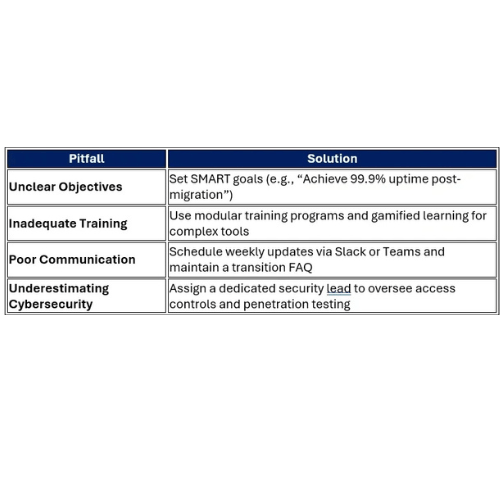
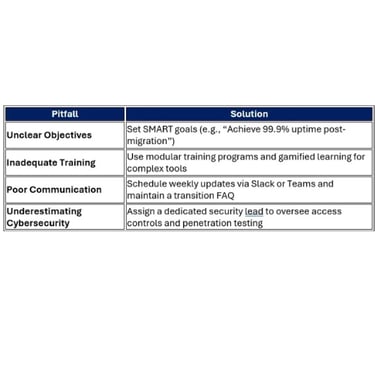
Common Pitfalls and How to Avoid Them
Measuring Success: KPIs and Metrics
Measuring success in an IT service transition is critical for ensuring efficiency, identifying areas for improvement, and demonstrating value to stakeholders. Key Performance Indicators (KPIs) provide a structured way to track progress, assess outcomes, and maintain accountability throughout the transition process. Without clear metrics, businesses risk losing visibility over the transition’s impact, leading to inefficiencies, delays, and missed opportunities for optimization.
Why KPIs Matter in IT Service Transition
Ensures Alignment with Business Objectives – KPIs help ensure that the transition meets strategic goals, whether improving performance, reducing costs, or enhancing security.
Tracks Operational Impact – By measuring system uptime, incident resolution times, and user adoption rates, businesses can gauge the transition’s effect on day-to-day operations.
Mitigates Risk – Monitoring security metrics, compliance adherence, and downtime rates allows teams to proactively address vulnerabilities before they escalate.
Enhances Stakeholder Confidence – Executives and decision-makers rely on quantifiable data to evaluate the transition’s success and justify future investments.
Supports Continuous Improvement – Post-transition analysis using KPIs helps refine processes for future IT upgrades, ensuring long-term efficiency.
Key KPIs for IT Service Transition
Change Success Rate
Track the percentage of changes deployed without incidents (target: ≥95%)Incident Reduction
Measure post-transition incidents caused by configuration errors (aim for <5% of total incidents)Compliance Adherence
Audit compliance with internal policies and regulations quarterlyUser Satisfaction
Conduct surveys to gauge ease of adoption and perceived system reliabilityCost Efficiency
Compare pre- and post-transition costs per ticket or infrastructure spend.Downtime Percentage
Track system availability before, during and after transition.User Adoption Rate
Assess how effectively employees and customers adapt to new systems.Compliance Adherence
Confirm that security and regulatory requirements are met.
By leveraging KPIs, businesses can quantify success, optimise future IT transitions, and safeguard operational continuity, making them an indispensable tool in IT transformation initiatives.
Cybersecurity Considerations During IT Service Transitions
IT service transitions can introduce significant security vulnerabilities, as systems, data, and access controls are modified or migrated. During transitions, businesses may face data exposure risks, unauthorised access, and system misconfigurations, making them prime targets for cyber threats.
To mitigate these risks, organisations must implement robust security measures to protect sensitive data such as:
· End-to-end encryption
· Multi-factor authentication (MFA),
· Strict access controls
Conducting comprehensive security audits and penetration testing before and after migration helps identify potential weaknesses. Additionally, businesses should follow compliance requirements such as GDPR, HIPAA, and ISO 27001, ensuring that data handling and storage meet regulatory standards. A zero-trust security model, where every access request is verified, can further enhance protection during transitions.
Establishing incident response plans and continuous monitoring ensures that any anomalies or breaches are detected and addressed promptly.
By prioritising cybersecurity throughout the IT service transition, organisations can minimise risks, maintain compliance, and safeguard their digital assets against evolving threats.
When to Buy-In Expertise
While internal IT teams play a crucial role in transitions, external expertisecan be invaluable for complex projects. Consider hiring IT consultants, managed service providers (MSPs), or cloud migration specialists when:
Your team lacks specialised knowledge (e.g., cybersecurity, cloud architecture).
The transition involves high-risk components, such as mission-critical applications.
You need faster implementation with minimal disruptions.
Compliance requirements demand expert oversight.
Cost-benefit analysis favours outsourcing over in-house execution.
Conclusion
A seamless IT service transition requires strategic planning, stakeholder engagement, security measures, and continuous optimisation. By addressing key challenges proactively and leveraging external expertise when necessary, businesses can enhance efficiency, reduce risks, and drive digital transformation successfully.
Whether upgrading legacy systems, migrating to the cloud, or integrating new technologies, following these best practices ensures a smooth, secure, and cost-effective transition.
Seamless transitions for service continuity
If you're preparing for an IT transition, now is the time to assess your strategy, engage stakeholders, and implement governance frameworks to ensure a best possible outcomes. Need expert guidance?
Get in touch with Strategic Consulting today — we specialise in minimising disruptions through our expertise in managing the introduction of new services or retirement of existing ones, helping you to navigate even the most complex transitions with security and confidence.
Explore
© 2026. Copyright Strategic Consulting Limited. All rights reserved.
Legals
Follow Us
Blogs & Case Studies